Through my extensive travels around the world, I learned a great deal about the gaps between travelers’ needs and what existing applications offer. I decided to define and design an application that would enable travelers to gain much more value in planning and executing their journeys.
Research
User research
I started with a user research, a questionnaire unsewered by approximately 24 participants, followed up by interviews with part of them. I reached the participants through dedicated Facebook groups for travelers in European cities. Bellow are the key findings from the research:
General characteristics
90% were between the ages of 29-55, with a nearly balanced gender ratio.
The average monthly income ranged between 5,000-20,000 ILS, with most earning above 10,000 ILS per month.
46% solo travelers, 35% families with children, 23% small groups of friends.
Travel Preferences
90% of participants would use a travel app for trip planning, but most still want control over daily adjustments. Only 10% found it unnecessary.
75% preferred using public transportationand walking.
25% stated they would rent a car, and 20% said they would use taxis (there may be overlap between these groups).
Only 2% expressed interest in renting bicycles.
75% relied on Google Maps for navigation.
68% rated their technological proficiency as high, while 29% had a medium-high level of proficiency.
Only 3% considered their technological skills to be low.
Needs & Frustrations
Planning a trip is a frustrating and time-consuming process, requiring travelers to sift through endless information from blogs, travel groups, and apps. The overwhelming selection makes it difficult to filter options, often leading to compromises.
Many participants expressed a desire to connect with fellow travelers in real time and receive recommendations from locals to discover hidden gems beyond typical tourist spots.
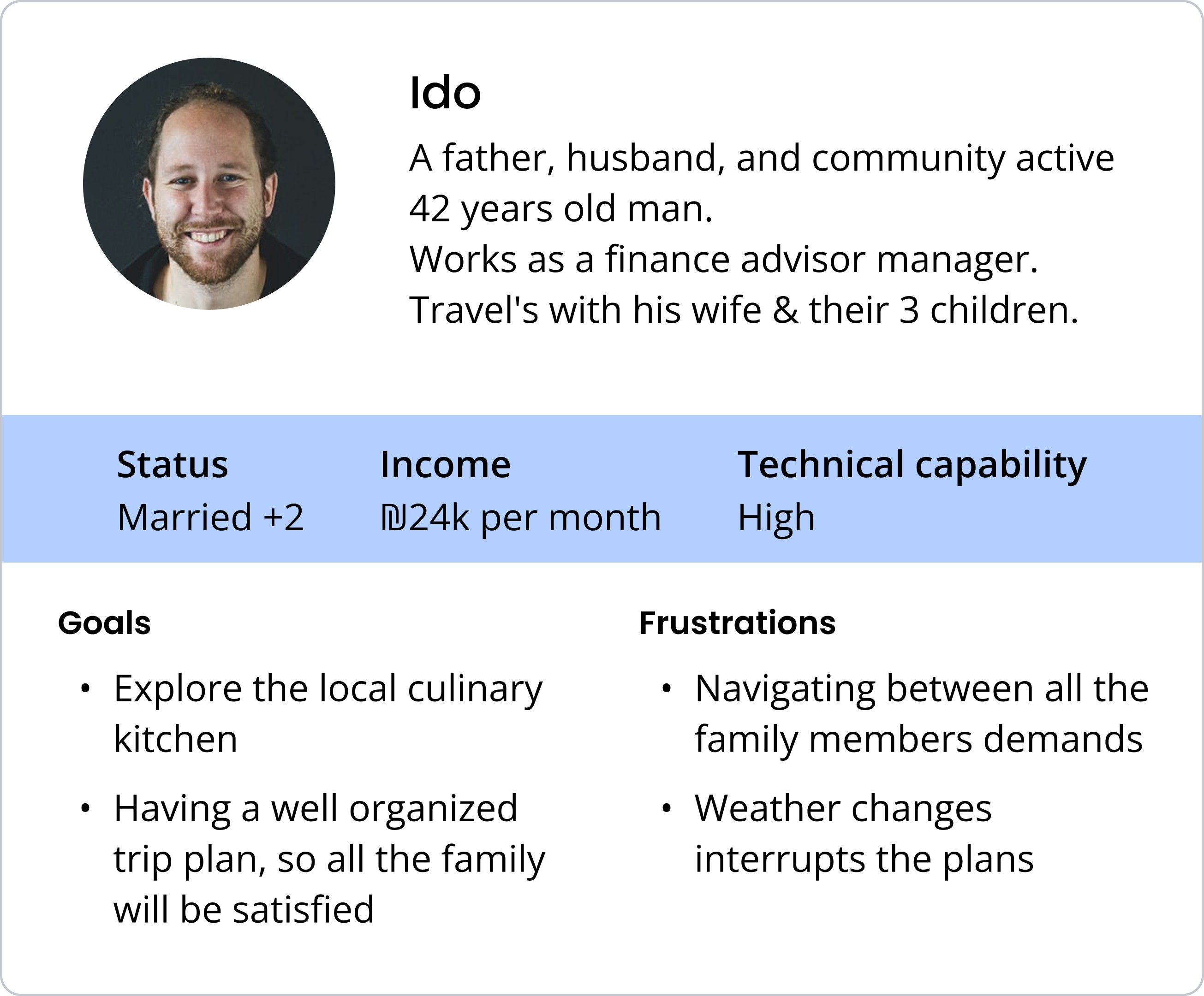
Personas
Competitors Analysis
The dominant platforms in the market, such as Google Reviews and TripAdvisor, suffer from significant disadvantages.
They lack essential features for trip planning and execution, such as timeline organization and optimal transportation recommendations.
Additionally, these platforms are overloaded with options, forcing travelers to sift through countless irrelevant suggestions before finding something suitable.
Ideation
Application's Attributes
App Identity
I defined a set of core values to guide the design process: Intuitive, Pleasurable, Vibrant, and Supportive. These values were derived from the general domain of the app (travel) and key insights identified during the research phase.
Core Features
The app will include a few primary capabilities:
Trip-planning algorithm: Users will go through a customization flow (optional) to define their interests, travel habits, and priorities, allowing the algorithm to create a tailored personalized attraction discoveryand execution.
Real-time management system: Helps users with navigation, time organization, safety, and logistics.
Group travelers: The app will support collaborative trip planning, enabling multiple users to coordinate their itinerary with shared editing permissions.
Connection: For travelers who wants to meet new people or connect with locals.
Site Map
The app’s navigation is primarily handled through a fixedbottom navigation bar, a search mechanism and links to common actions from the Home screen.
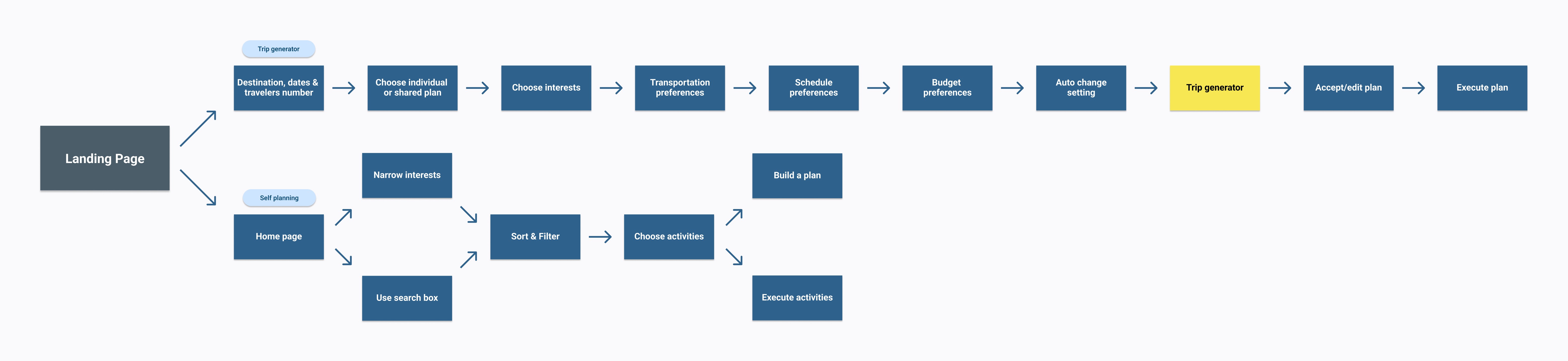
User Flow
From registration to operation
System Design
Typography
Poppins for headings and buttons: a geometric sans-serif font with a clean, mono-linear structure, enhances intuitiveness and user-friendliness. Its multi-script support (Latin & Devanagari) makes it well-suited for an internationally-focused platform.
Open Sans for body text, labels, and descriptions: a humanist sans-serif font that supports Latin and Cyrillic alphabets. It is modern, approachable, and highly readable on screens.
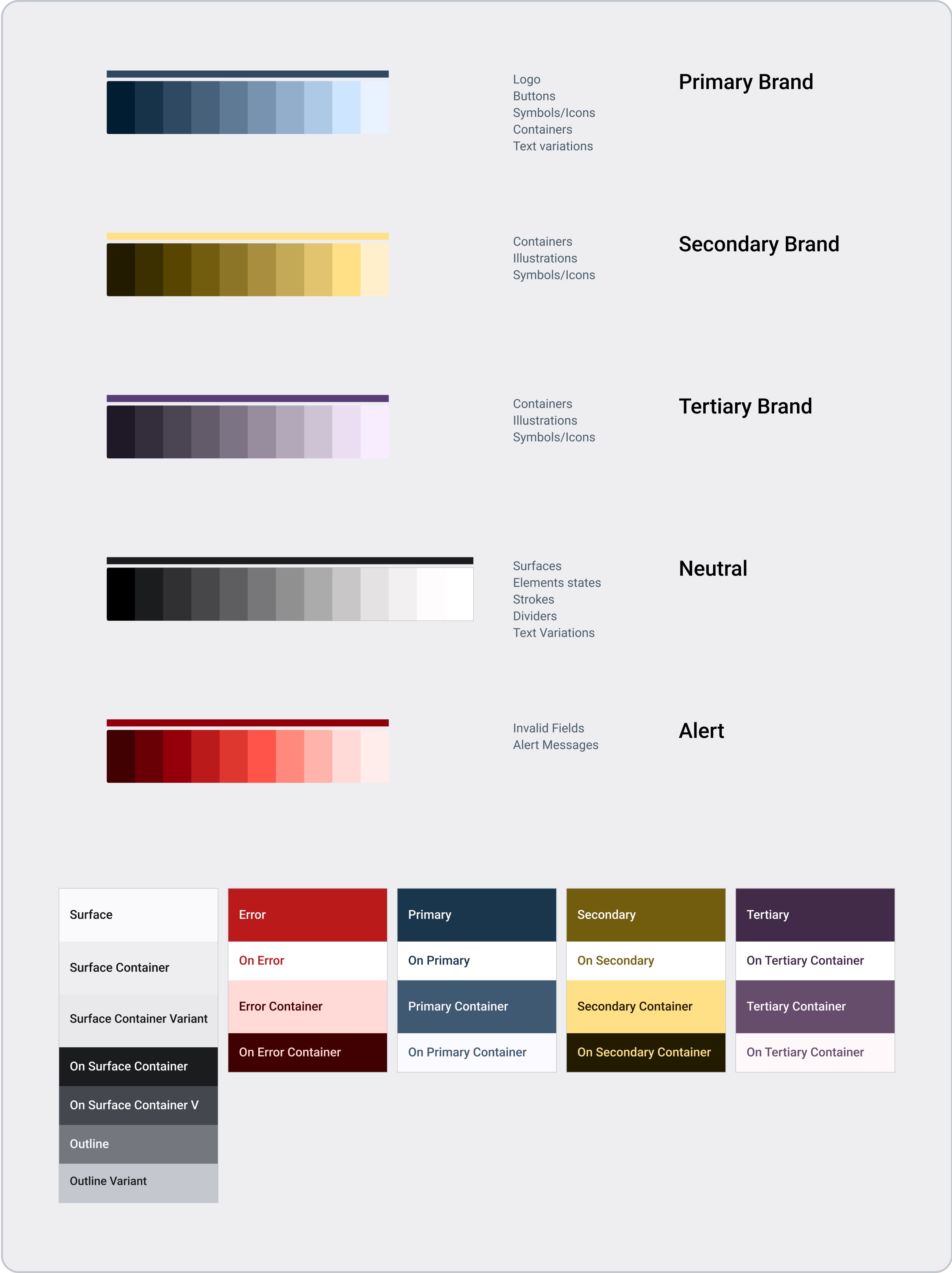
Color Palette
The primary color, Aegean Blue evokes the calm and clarity users seek amidst trip planning chaos, while also symbolizing the authentic connections and hidden gems the app helps them discover.
The secondary color, a yellow-orange, adds a touch of adventure and energy, creating a balanced yet dynamic contrast with the blue.
Business Model
The app will generate revenue through in-app bookings, partnerships, and sponsored content:
In-app bookings & partnerships
Sponsored listings & ads
This model creates diverse revenue streams while keeping the platform valuable and user-friendly.
Wireframes
Personalization process
The personalization process allows users to tailor their trip based on their preferences and travel habits. Trip generator prototype (starting after inserting the trip details):
To ensure the personalized trip generator delivers an optimal user experience, a subsequent usability study is critical. This research will measure key metrics like time on task, drop-off rates, SUS, and NPS to validate its intuitiveness and efficiency.
Additionally, integrating a group planning feature is a high priority to facilitate seamless collaborative itinerary building for multiple travelers.
Home Page
The home page enables quick entranceto execution, while offering additional suggestions and inspiration such as nearby activities, blog posts and travel tips.
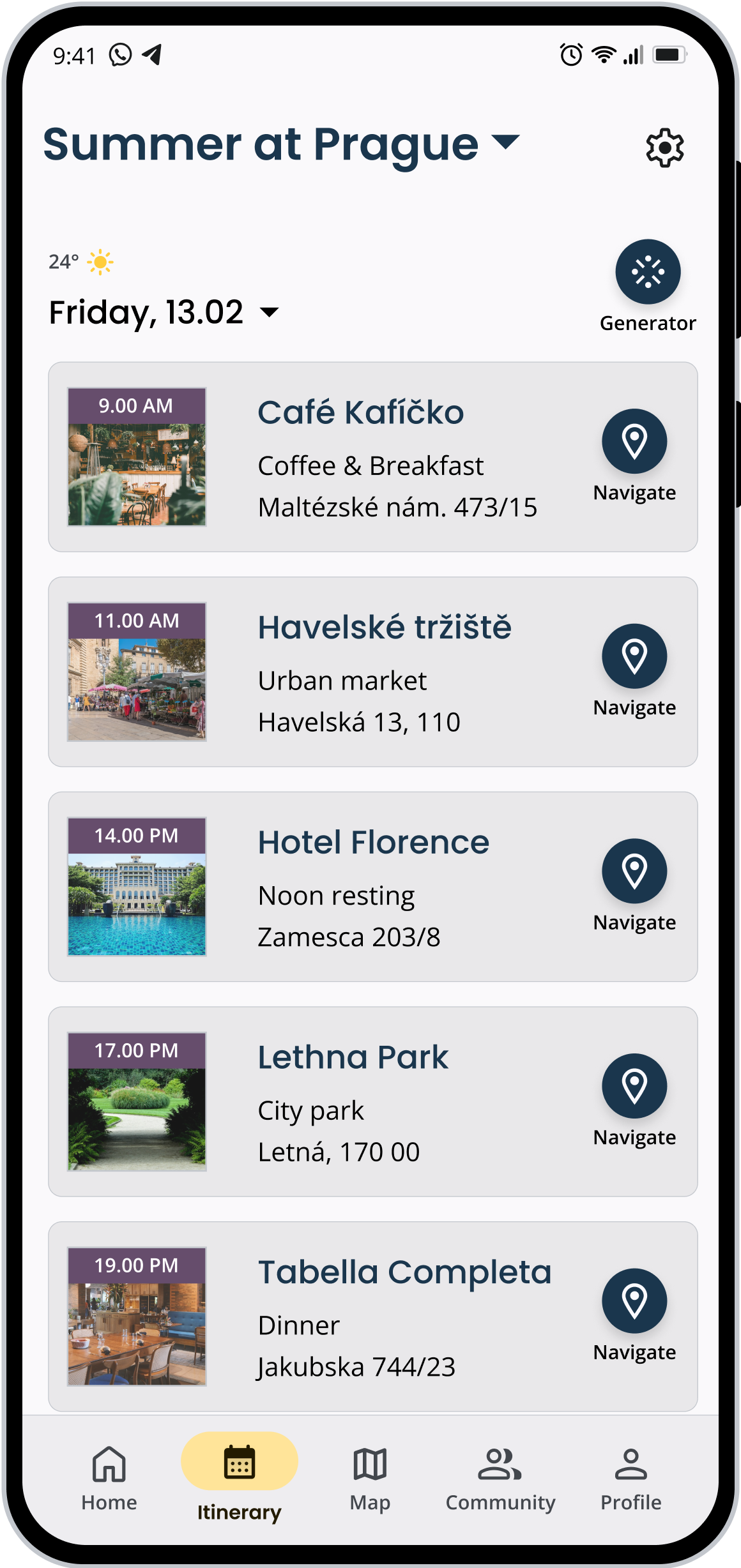
Itinerary
Trip itinerary review, modifications and generate new itinerary. Setting supports auto schedule adjustment allowing the app to suggest changes in response to factors like weather or delays.
Community
Users can connect with travelers, find trip partners, and attend social events such as pub crawls, with all interactions supported by a chat platform for personal or dedicated group discussions.
Activity Page
On the activity page, users can easily access reviews, media, and additional details. For active bookings, the page includes booking details and quick actions like navigation, modification, and direct contact.
Other features
There are a few other features that I didn’t design yet, but can improve the over all experience for travelers:
The Favorites page, where users save activities and content, was repositioned from the main menu to the map and personal profile. This decision optimizes the real-time user experience by reducing clutter in the main menu, allowing travelers to focus effortlessly on live navigation and in-city exploration when their cognitive load is higher.
A future payment system will enable seamless transactions within the app, offering users exclusive discounts and perks.
An integrated expenses tracker will allow users to monitor trip spending and set daily budgets for efficient financial management.
The Blog section will offer valuable insights and inspiration through traveler blogs, local recommendations, general travel articles, and safety tips
Map
The map view is a key feature of the app, allowing users to navigate, search for attractions and explore their surroundings.
The map adapts to different modes based on user preferences:
Standard mode: Displays the area, scheduled attractions, and saved content.
Navigation mode: Guides users to their destination based on their preferred transportation method.
Itinerary mode: Shows a route connecting upcoming attractions according to the planned schedule.